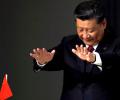
'Ladakh is a tiny salami-slice issue.' 'The big one for China is Arunachal Pradesh, more than 83,000 sq km.' 'Do they imagine they can grab any of this by force?' 'In the 21st century, nursing those thoughts only means you need to get your heads examined.' 'It isn't going to happen,' declares Shekhar Gupta.
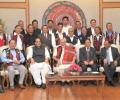
'NSCN-IM leader Muivah warns that the NSCN-IM has come very close to an honourable solution to the peace process with the Government of India, but if it does not materialise, then the Nagas will go away so far that it would be difficult to bring them back to the negotiating table easily,' note Sandeep Pandey and Meera Sanghamitra.
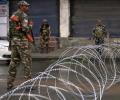
Schools in the Valley will reopen next week, Jammu and Kashmir Chief Secretary B V R Subrahmanyam said.

'Over the last two decades, the India-French relationship has grown steadily, no major political difference having darkened the sky between Paris and Delhi,' says Claude Arpi.
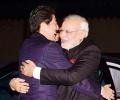
'The regional context and the personal ties between Modi and Japanese Prime Minister Shinzo Abe to a large extent contributed to this dawn of a new era in bilateral relations,' says Srikanth Kondapalli.

Bharati Dutt witnessed life-changing events that shaped India on the threshold of freedom. Her memories are an account of how ordinary Indians saw India change.
'Both India and Pakistan are now, for the first time in history, very closely allied and connected with the US -- economically and politically.'

'The response to savagery and mass injustice is never a persistent howl.' 'There will be, among the victims, those who choose to forget the scars, those who go on living, those who challenge the overall environment of sentimentality.' 'And the more effort you put into including these other voices, into assimilating these spoilsports, the more balanced your depiction of the tragedy in question will be,' observes Sreehari Nair.

Lashing out at Congress President Sonia Gandhi for "playing with the lives of Telugu people" and "murdering democracy in broad daylight", YSR Congress chief Y S Jaganmohan Reddy on Saturday called on Telugu people to give 30 Lok Sabha seats to his party in the forthcoming Lok Sabha elections to stop the division of Andhra Pradesh.
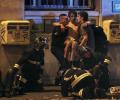
'As Mumbai showed, and the Nairobi Westgate Mall attack reinforced, "guerrilla-style terrorism" has increasingly become the method-of-choice for terrorist groups,' says terrorism expert David Kilcullen.

From the Aadhaar verdict to #MeToo's arrival in the country to the entry into the Sabarimala temple -- India had a newsworthy 2018. As we step into 2019, these are the top moments from the year gone by.

'She's not going to keel over.' 'This is the kind of difficult situation that she thrives in.'

'Absolute non-violence is not only sinful, but immoral.' 'This doctrine of non-violence benumbed the revolutionary fervor, softened the limbs and hearts of the Hindus, and stiffened the bones of enemies.' A revealing excerpt from Vikram Sampath's Savarkar (Part 2): A Contested Legacy, 1924-1966.

'I want to show that we are also part of this society and want to participate just as much, whether it is for security or whatever community work there.'

General T N Raina was an iconic Indian military leader whose contributions to the nation should be more widely known, notes Lieutenant General Syed Ata Hasnain (retd).
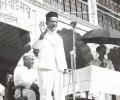
Savarkar believed Swarajya is more than the mere geographical independence of a stretch of earth called India. There was no point in fighting and sacrificing one's life for a Swarajya (mere territorial independence) at the cost of our Svatva (self-existence) or Hindutva itself! A revealing excerpt from Uday Mahurkar and Chirayu Pandit's Veer Savarkar: The Man Who Could Have Prevented Partition.

'The Pakistanis were not the mujahids or terrorists as claimed initially.' .'They were trained soldiers who held state of the art anti-aircraft missiles to shoot down our airplanes.'

Kapil Dev's historic World Cup win wasn't the only highlight of 1983. Sukanya Verma looks back how the year treated Bollywood.
'In India, a really popular and well-entrenched leader is not defeated by a rival.' 'Such a leader has to defeat himself,' observes Shekhar Gupta.

The British home secretary has granted permission for jeweller Nirav Modi's extradition to India. During their arguments in a London court, his lawyers claimed Modi suffers from mental illness and is a suicide risk if he was sent to Mumbai's Arthur Road jail. A fascinating excerpt from Danish Khan and Ruhi Khan's Escaped: True Stories Of Indian Fugitives In London.

Lt Col Raja "Grinder" Chari, 39 is in the batch of 2017.

'Earlier India as part of the Third World fought for the rights of the Palestinians. But oddly the defeat of the Congress and the decline of the Nehruvian imagination has altered such perceptions. The new middle class expresses an open sympathy for Israel, contending that Jews like many Hindus has been misunderstood,' says Shiv Visvanathan.

'India has both the wherewithal and the will to fight the enemy, but is living in a make believe world of its own since it is yet to accept that it is indeed at war,' says military historian Colonel Anil A Athale (retd).
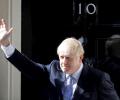
Johnson becomes the 14th Prime Minister to be appointed by Queen Elizabeth II, the 55th to hold the post of British PM and the third in fairly quick succession since Britain voted to leave the EU in June 2016 - following on from David Cameron and Theresa May.
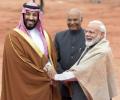
'The more emphatic denial of any proposal for an OIC foreign ministers meet in Islamabad appears aimed at keeping Pakistan on a leash,' notes Lieutenant General Syed Ata Hasnain (retd).

Colonel Anil Athale (retd) recalls how the Battle of Panipat, 258 years ago, changed the history of India for the next century and half.
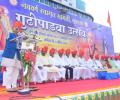
'We must not forget who we are and what courage and bravery were shown by our ancestors to bring us closer to the freedom we enjoy today,' says Tarun Vijay after attending the Gudi Padwa in Goa.

"The weak don't survive, the strong survive. You make peace, alliances with the strong. You are able to maintain peace by being strong," he said.

Indian politics, held captive in one way or the other by Ayodhya, may now well seek its emancipation from this issue, and the pursuit of welfare, asserts Congress leader Salman Khurshid in this excerpt from his latest book, Sunrise over Ayodhya.

Here's the full text of President's address with a word cloud.

The BJP knows the CAA, combined with a fresh nationwide NRC process, is an idea that's dead on arrival. Where it lives on is as a divisive, polarising instrument as its rivals have to take a position against it and thereby be exposed to the charge of 'Muslim appeasement' again, points out Shekhar Gupta.
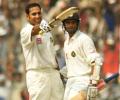
20 years ago this week, India and Australia played one of the greatest Test matches in cricket history. Sreehari Nair relives the sound and the fury of that unforgettable game at the Eden Gardens.
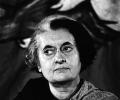
'According to me, her finest hour was in 1983-1984 when she neutralised a combined US-Pakistan-British conspiracy to Balkanise India by creating an independent Sikh State of Khalistan,' says Colonel Anil A Athale (retd). A special assessment of Indira Gandhi on her centenary.

On the second leg of his trip to Central Asia, Narendra Modi makes quite an impression in Astana, as he talks about terror and trade, films and the future

An excerpt from Conde Nast India's Make In India magazine.

'We don't know what the reasons were that we gave back the Haji Pir Pass which was strategically very important. Today the entire infiltration into Kashmir takes place from that area. If we had retained that post that we had captured, things could have been different.' 'A lesson we need to learn is if you start losing the gains of war at the negotiating table, they become a disincentive for future wars,' says Lieutenant General D B Shekatkar (retd), reviewing the lessons from the 1965 War.

'The Post's coverage is not an authentic public discourse guided by unbiased Western intellectuals, but a slanted doomsday propaganda orchestrated by Indians and expatriate Indians,' argues Vivek Gumaste.

The elements are all aligned to make India a global powerhouse, says IMF Managing Director Christine Lagarde.

'If we play our cards right, we may even benefit from the competition between the US and China as seen from increased investment from each of these countries into India.' 'The size of our market gives us an important lever of power which we shall have to play adroitly and intelligently,' points out Ambassador Gautam Bambawale -- who served as India's envoy to China -- in the Professor V M Dandekar Memorial Lecture 2019, delivered on March 8, 2019 in Pune.
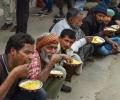
'All the hotels and restaurants from where I used to eat have been shut. I used to beg but now there is no one to give me alms too'
 © 2026 Rediff.com - Advertise with us - Disclaimer - Privacy Policy - Sitemap - Feedback - About us - Terms of use - Grievances